
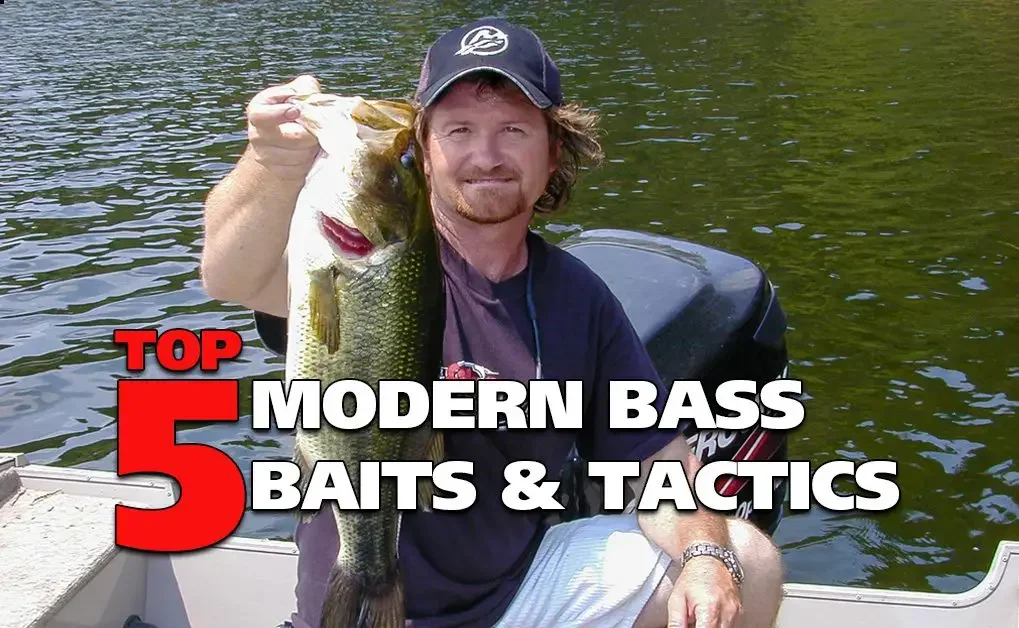
I absolutely love it when Bass season finally commences in my area. It’s the last opening day on the calendar and it’s my favourite. In actuality, it’s the only one that I celebrate with at least a boys’ get-together or, better yet, an actual “boys’ weekend” with some of my buds. It builds great memories—an unquestionable key in fishing.
Another aspect of Bass fishing that I love is that there is lots of reading material available on the web or in magazines (yep, they still exist) when I need a little top-up or entertainment. When I read Angelo’s latest piece (BasSmart Part 2: Where Bass Live and Eat), it pumped me up and brought me into the modern-day Bassin’ world: technical maps, seasonal movements, when, where and how they feed; it’s all great stuff (FYI, he’s got even more to come).
I had some inside info that Ang was going to go over a bunch of the tried-and-true Bass baits that, to this day, continue to hold their own. Knowing that, I thought I would dive into some of the latest and greatest techniques used around the globe—including newer and, shall I say, maybe even improved intricacies?
Whether you like change or not, the following rigs are quite interesting.
1 – THE TOKYO RIG
The Tokyo rig came to us from the far east, as do many modern Bass fishing techniques. The fish in Japan are apparently very heavily fished and, thusly, pressured. Savvy anglers are constantly tinkering with tackle and terminal gear, trying to come up with that little something that keeps them ahead of everyone else. The beauty of this is that nothing is ever a secret. Eventually, the word will travel westward and, in due time, make it to our shores. Usually, the tournament guys are the first to get wind of new ideas. Once they win an event or two, however, the top-secret rigging or bait will get out, guaranteed!
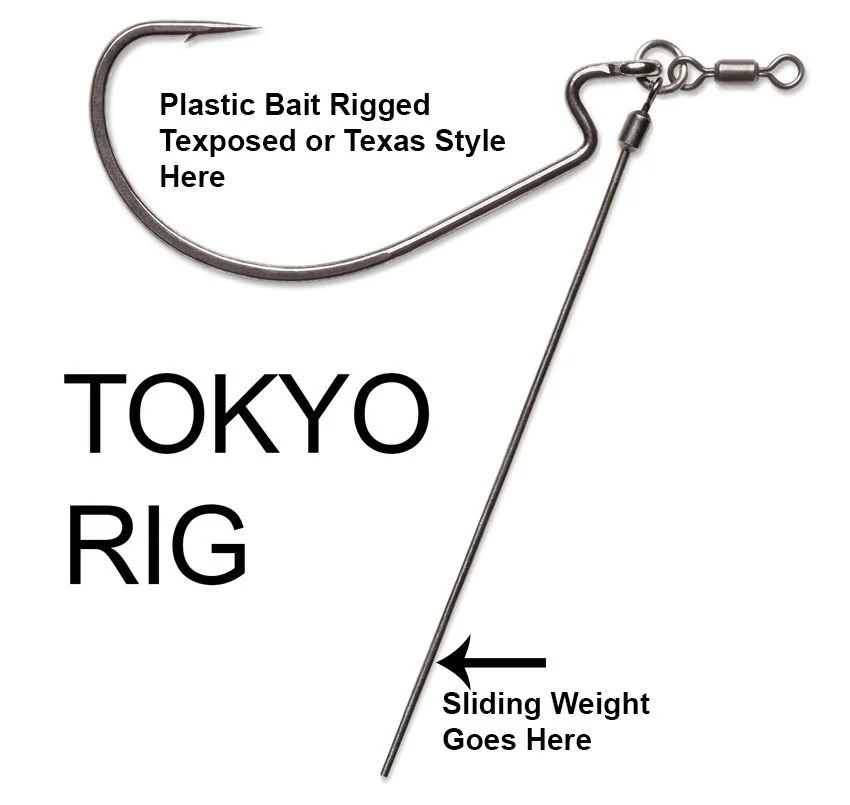 By adding a sliding sinker onto the hanging wire and your favourite plastic on the rig, you have a weedless presentation with lots of action.
The Tokyo rig seems extremely crude at first look. It’s a hook, a ring, a swivel and a piece of wire. By adding and securing a sliding weight to the hanging wire and then your favourite plastic bass bait, the rig is complete.
Finesse? I Think Not!
When it comes to finesse fishing, you will often hear of rigging like 5-pound test fluorocarbon leader tied to an 8-pound test ultra-thin braid. Couple that to a tiny technique-specific, chemically sharpened hook with just enough weight to slowly creep a thin-profiled bait down to the bottom. Compared to that, the Tokyo rig looks anything but finessed. It’s exactly the opposite. That said, it truly does have a time and a place here in North America and, in our case, Canada.
Why The Tokyo Works
The key to this rig is the action on your offering. Forget all about that hardware and think only about the plastic bait. On a Texas rig, the weight is at the nose of the plastic and your line is tied directly to the hook (heavy fluorocarbon equals stiffness). When you lift the bait off the bottom, the plastic follows the weight. It looks good, and it works. But there’s no freedom in how that plastic flows at the head of the bait. With the Toyko rig, it’s all about freedom of movement at the front of the plastic with the hinging action. The little ring is the key. All the rig’s parts flow freely along that ring allowing the bait to undulate like no other.
I must admit, I haven’t fished this rig much as of yet, but I’m liking the initial results and am committed to sticking with it since I know it works. And get this: My first ever Tokyo rig fish was a Muskie about 36-38” while Smallmouth fishing, and my second was a 24½” Walleye with a small swimbait on a Tokyo rig (while Walleye fishing, incidentally, I thought, What the heck, I’ll try it).
Trust me, this rig is beyond effective on Bass. Let’s just say, if you’re fishing a milfoil weed bed for Largemouth, tie a Tokyo rig on with some kind of beaver or craw bait. I’ve got a feeling you’ll like it.
Check out how our good buddy Roland Martin makes his own Tokyo Rigs here.
2 – THE NED RIG
The Ned rig has been around for a while, but I still need to mention it here. A man named Ned Kehde came up with the concept out of his desire to simply “catch lots of Bass.” And he wasn’t looking just to catch a couple of “hawgs” and call it a day, either. He wanted action all day long. Thus, the Ned rig was born.
Ned fishes from 3 to 15 feet of water and mostly uses 1/32- and 1/16-ounce jig heads. He likes either a “do-nothing” type of retrieve by swimming lure from 6 to 12 inches off the bottom or by adding a slight shake to the bait. Believe it or not, he prefers 15-pound braid. That sounds heavy, but it’s not. It’s all about the line diameter and the sensitivity.
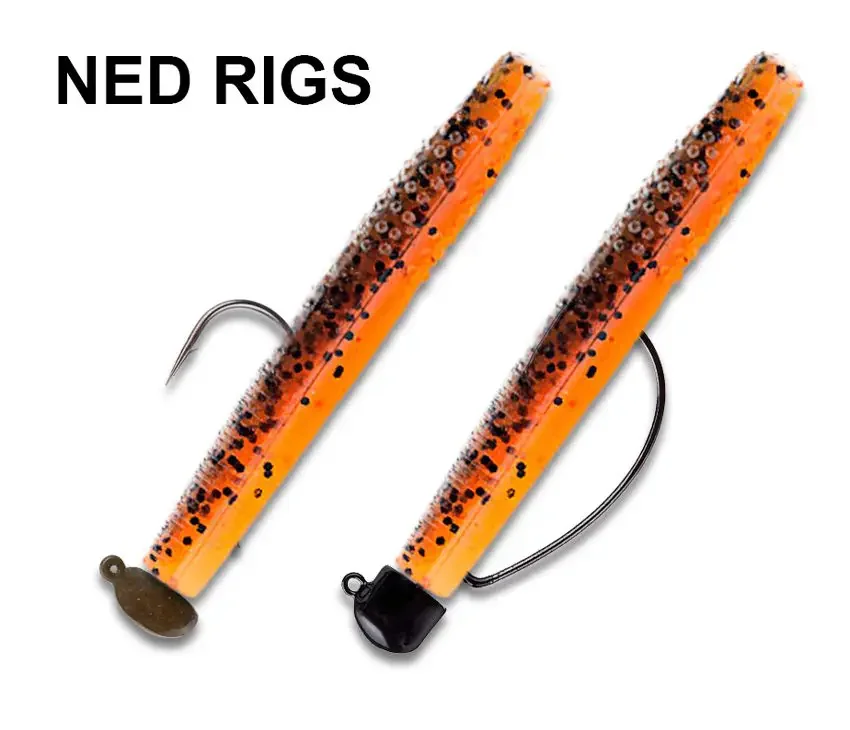
By far, the most popular Ned plastic is the TRD by Z-Man. This may be the toughest little finesse worm I’ve ever used. You can use, reuse, and abuse these babies all day long and honestly, they’ll often outlast you. Some plastics are only good for one or two fish, but Z-Man plastics are the most resilient out there.
The other quality that makes these work well on the Ned rig is the buoyancy of the TRD. It floats. So, when the jighead hits bottom, the tail of the bait is sticking upward—extremely easy for a Bass to see.
Other companies make baits similar to the TRD. For example, Yamamoto makes a 3” Senko, which works great, but it rips easily.
If you don’t like the idea of Ned’s 15-pound test braid, then try 6- or 8-pound fluorocarbon on spinning gear. It works, too.
3 – THE CHATTERBAIT
Also known as the Bladed Jig, the Chatterbait has certainly made a name for itself over the last few years. The idea is simple. It’s a fast-moving bait that covers water in the same sense as a Spinnerbait or a Crankbait. You cast and reel as many times as possible to capitalize on the most bites you can get in an outing.
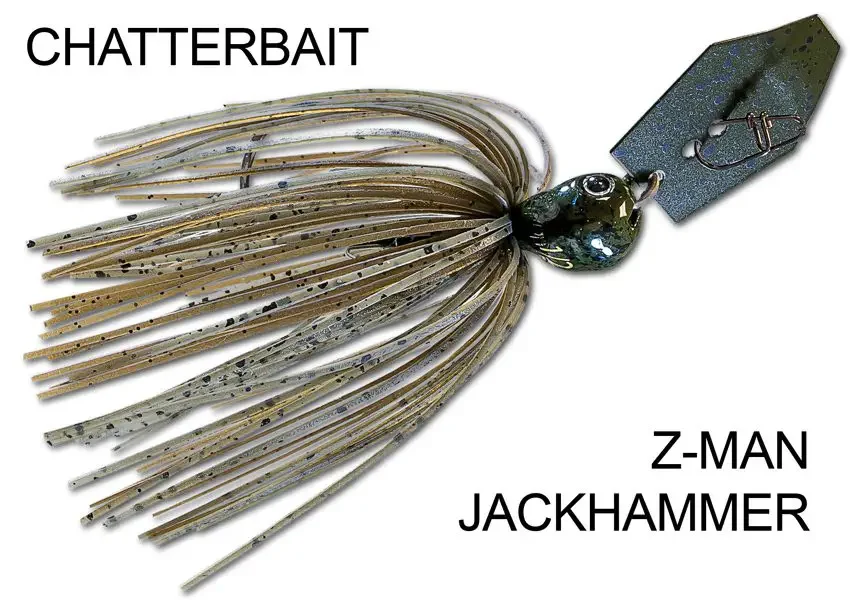 Expensive but by far the best Chatterbait on the market today
I learned to fish a Chatterbait out of necessity. I have a fishing buddy that has sworn by them for years. Loves ’em. One day, he and I were fishing an amazing piece of water. While I (probably using a jig) was on the bow of the boat, Mr. Chatter was chattering along in the back, slinging in Largemouth after Largemouth.
“That’s enough,” I thought—time to eat crow and learn.
What makes a Chatterbait different from other fast-moving baits is the extreme vibration, the incredible undulation (side-to-side) and the lack of loud sounds emitted. It’s like a clanging spinnerbait minus the steroids; it’s like a clacking Rattlebait, without the loud ticking, if you get my drift. A Chatterbait isn’t silent, but it’s not ridiculous-loud either.
The beauty of this bait, however, comes once a trailer is put into play. A small swimbait or even a skinny craw bait are what I prefer. Bass Baits like a Yamamoto Zako, small Swim Senko, or a Zoom Speedcraw are perfect. They have action on their own, but once tagged onto the hook of a Chatterbait, they really come to life.
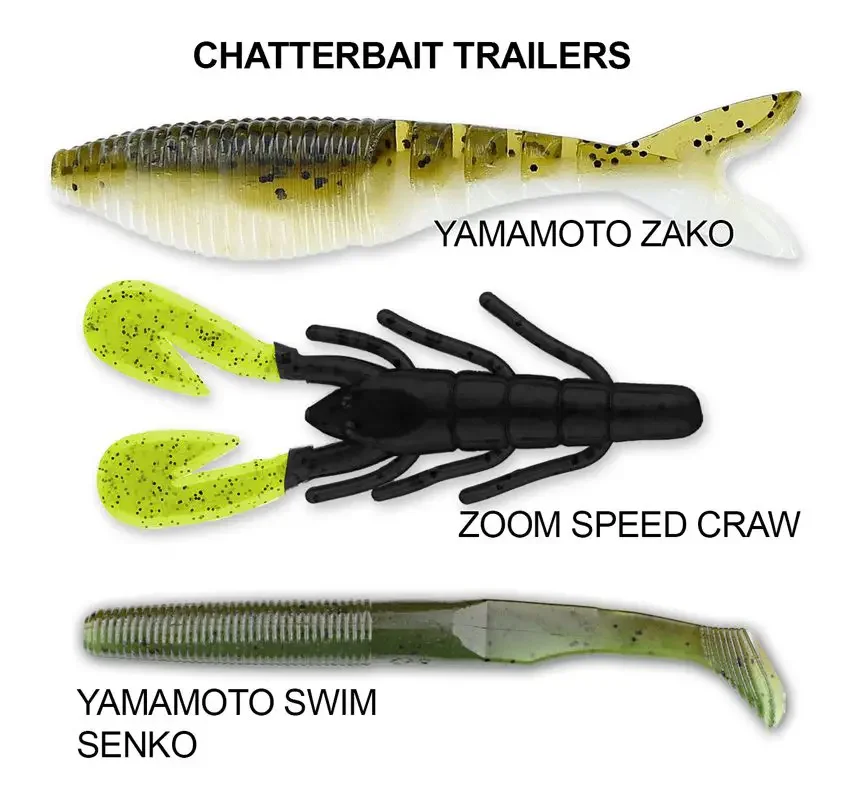 Three great trailers for a Chatterbait.
In Canadian waters, I’ve done well on black/blue (dirty or dark water), pumpkin (where lots of panfish exist) and the odd time on white or clear to look like baitfish (Alewife, Cisco, Shad, etc.) in gin-clear water. The main colour of the trailer should resemble the primary colour of the bait, but you can vary the accent colours such as claws, etc.
CONTINUE TO PAGE 2 FOR PETE’S FINAL TWO PICKS FOR THE TOP 5 MODERN BASS BAITS
4 – THE NEKO RIG
Some people pronounce it like “echo” with the letter n in front of it. Others pronounce it like “nee-ko” as in knee with a ko at the end of it. Both are probably correct. But honestly, I don’t really care.
The Neko rig was derived from the wacky style rigging on a soft stick-worm while looking for something a bit different. It still uses the same bait and an O-ring to hold the hook on, but then things change. Although it may not look too much different from a wacky rig, it acts very differently.
The most significant difference is the addition of a weight into the head of the bait. It’s not a weight on the line nor the hook nor a jig head; it’s a push-in weight that, once slid or stuck into the head of the worm, gives the presentation a whole new look.
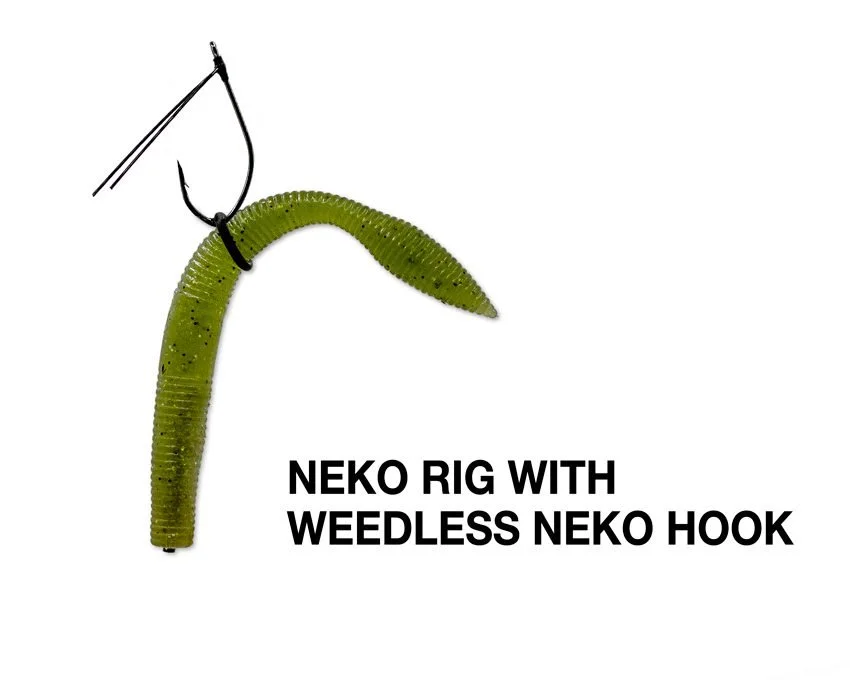
Again, I’ve used this rig and caught some Largemouth on it. However, I haven’t used it much. Not nearly enough to give you the thumbs up or down. I will say that once you get a feel for this rigging, though, it’s awesome to watch work.
The idea is to let the bait fall down nose/headfirst and then hit bottom with the butt or tail sitting upwards, of course. You would swear that it looks like something feeding off the bottom of the lake. By imparting a slight shaking action, things really start to look real. I believe this action is the key to its success. I’ve tried it with 4-, 5- and 6-inch stick-worms but found that 4” is best for me so far.
5 – SWIM JIG
Finally, our last bait of the modern era: the Swim Jig. This bait is a derivative of the tried and true Flipping Jig or the Grass Jig. The main difference is in the head style and shape.
I’m not sure how much you have thrown around a Bass jig before, but I do know how much I throw it. A lot! I’ve pretty much always got one tied on unless I’m working on a new technique, which absolutely requires me to leave that jig at home (Otherwise, it’ll be in my hand eventually, and the new technique will have to wait for another day).
I’m probably not going out on much of a limb by saying that the Flipping Jig is my all-time best big Largemouth catcher.
The Swim jig looks almost identical; however, it has some subtle differences. Its head is designed more to pierce the water during a horizontal retrieve. A flipping jig has a flatter head, allowing it to sit nicely on the bottom. Different manufacturers make subtle differences in their Swim Jigs, but, essentially, they’re all made to be cast out and reeled in.
You can use the same trailers as I’ve noted above in the Chatterbait section.
I Learned To Swim A Jig By Sheer Luck
Are anglers lucky or skilled? You tell me. I remember many years ago when I caught my first Largemouth by swimming a jig. I was dunking some weed pockets in around 8 feet of water, and I fired out a cast that I didn’t like, so I quickly—or should I say rapidly—reeled in my black/blue with a chunk jig. About three-quarters of the way back to the boat, a decent Largemouth ripped up from the weedbed and engulfed my jig. I couldn’t believe my eyes. I was tearing that thing back in like you would not believe, not even looking for a fish, just saving time.
Here’s another scenario that happened to me many years ago: It was during the same outing as when I caught that big Largemouth in the feature image of this article. Earlier in the day, I pitched my jig towards a dock but came up short. I started to rip it back faster than fast could be, and a 3+ took a b-line towards my bait. Unfortunately, that fish saw the boat and bolted the opposite way—another addition to my Swim Jig life lessons.
From those moments on, I almost always (when conditions dictate) finish off my Jig pitch or flip by swimming the bait back to the boat. I must assume this has happened to many Bass anglers, and that’s one of the reasons why they came up with the Swim Jig.
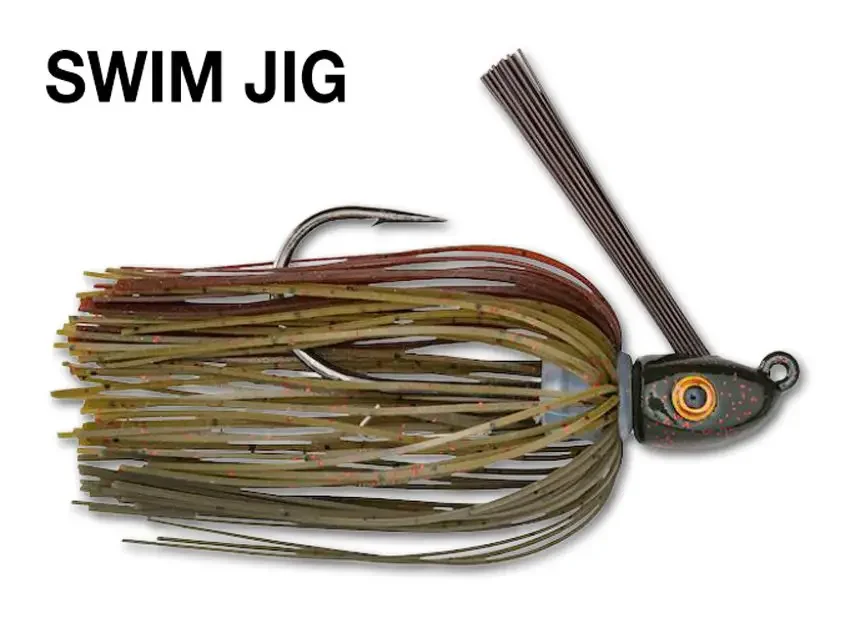 A bait like this Strike King Hack Attack Heavy Cover Swim Jig looks almost the same as a Flipping jig, but there are some differences.
I will add here that I like to impart a slight rod-tip action to my swimming jig. It gives it a subtle up and down motion to break up the monotony of a straight retrieve.
CONCLUSION
There you go, you Bass-hungry freaks! A handful of newer techniques to keep the wheels turning in that crazed, fishing-oriented brain of yours.
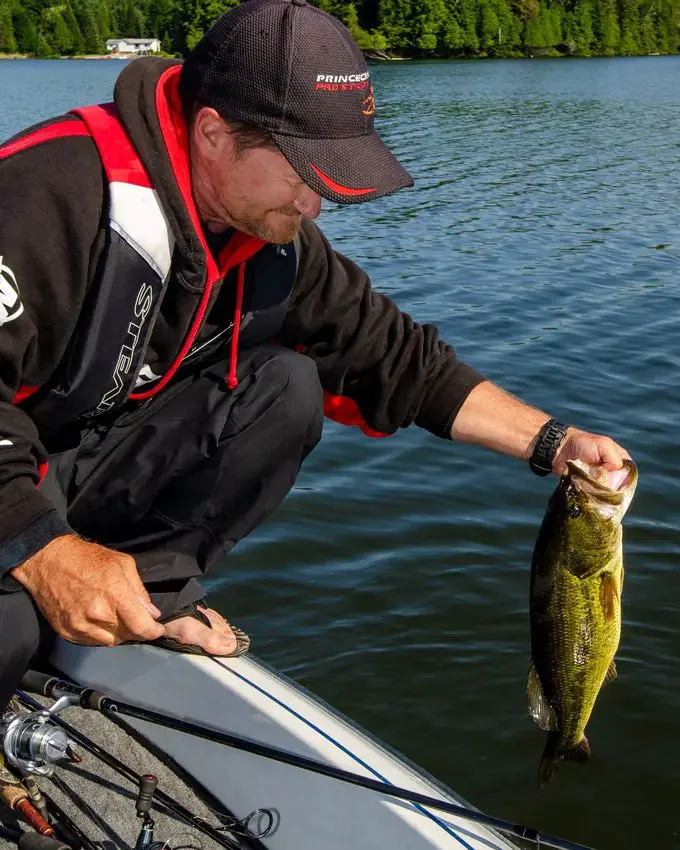 Spinning gear accounts for many of my annual Largemouth catches. Presentations like Ned rigs or sometimes Neko rigs are perfect for Spinning.
There’s no way that the tried and true Pop R or Jitterbug, Johnston Silver Minnow, Roland Martin Big Bass Spinnerbait, or Big O crank will be obliterated from our overfilled tackle collections. But maybe, just maybe, there’s room for something a little different.
Enjoy your Bass season, and please keep us posted on your progress.
Pete